
Your Tax Dollars, Your City: Why Fiscal Clarity Matters

Updated: Mar 29
City budgets aren’t exactly fun weekend reading. But here’s the thing: this is our money. And as neighbors who live on these streets, use these trails, and want this city to stay as special as it is — we deserve to know how it’s being spent, in plain English.
One commitment that matters deeply to me: making the budget understandable — regular updates, plain-language summaries, no jargon without explanation. With major growth planned throughout our city, the financial decisions we make in the next few years will shape Lone Tree for decades. Let’s get them right, together.
The Numbers Behind Our City
The City of Lone Tree already publishes a detailed budget every year — and it’s genuinely good work. The 2026 adopted budget is transparent, well-organized, and worth knowing about. The goal should be to bridge the gap between City Hall and your kitchen table.
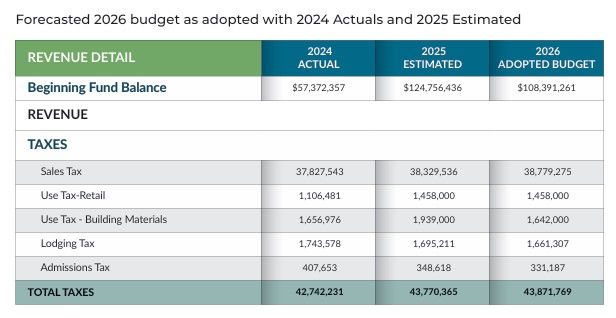
Here’s the headline: sales and use tax generates $40.2 million — 46.4% of Lone Tree’s entire operating budget. That’s what funds our police, our roads, our parks, and the services we rely on every day. Total tax revenue hits $43.9 million of our $86.7 million budget. These aren’t abstract numbers — they’re the foundation everything else is built on.
Why the Type of Growth We Attract Matters
Lone Tree has one of the lowest sales tax rates in the region — 2.5%, compared to Parker (3.0%), Castle Rock (4.2%), and Denver (4.81%) — yet we generate extraordinary revenue because of our retail volume. Annual retail sales top $1.5 billion. That’s a remarkable foundation. But as a City Council we shouldn’t take it for granted.
Residential growth is important — it brings families, vitality, and community. But homes generate costs: schools, roads, infrastructure, and services that need to be funded. The commercial and retail development surrounding our neighborhoods is what keeps the budget balanced.
Lone Tree should be intentional about attracting employment-based development that complements our existing business base — including professional offices, medical, and technology employers — particularly east of I-25. That’s what builds a resilient, diversified tax base and creates jobs that keep families rooted here. Our Comprehensive Plan, “Lone Tree Elevated,” already points in this direction. We should follow through on it.
Our Local Businesses Deserve a City That Has Their Back
Big retailers bring real revenue — and that matters. But local businesses are what make Lone Tree feel like a community rather than a corridor. The independent restaurants, boutique studios, local professional offices — those are your neighbors’ livelihoods.
Lone Tree should be genuinely easy to do business in — through responsive permitting, straightforward processes, and a city that treats local entrepreneurs as partners. When local businesses thrive, the benefit is circular: they hire neighbors, sponsor youth teams, donate to school auctions, and put down roots. That’s the kind of economic health that shows up in a community, not just on a spreadsheet.
If we want local businesses to stick around, we have to show up for them. If your neighbor’s café costs a dollar more than the chain down the street — that dollar is an investment in the community we all say we want.
Growth Should Pay Its Own Way
The RidgeGate East Planned Development — 2,000 acres east of I-25 — is already mapped out: three residential villages, a City Center, a second library, a second rec center, schools, and commercial districts. At full buildout, that could add an estimated 30,000 more residents and thousands of jobs. The Lyric community has already welcomed its first residents and is already into advanced phases of its development.

The 2026 budget reflects $138.8 million in total expenditures against $86.7 million in revenues — a gap driven by major one-time investments including the Justice Center, the expanded Public Works Facility, and High Note Regional Park (nearly $29 million in 2026 alone). That’s responsible capital planning. But it’s also a reminder that growth isn’t free, and we need to see those costs coming.
Fiscal stewardship isn’t about saying no to everything — it’s about being honest, thinking ahead, and making sure every dollar serves the people who live here. With Lone Tree's roadmap already in hand and a real estate lens on the numbers, we have every reason to get this right.
Keep Lone Tree Special.
About Tara
Tara Meekma is a Lone Tree resident, real estate professional, wife and mom. She is running for Lone Tree City Council, District 2 in the May 5, 2026 election.


Tara, what is your plan to require developers to shoulder responsibility that matches their enthusiastic building? Parking, contribution to improved road structure required by dense housing, contribution to help cover increased services demand? Property originally zoned for retail has been rezoned for residential, reducing the proportionate retail tax base that made lone tree so attractive when we moved here in 2011. Developers, meanwhile , make a $ killing and skate on responsibility. Also, what are you plans to work with South Suburban to upgrade the rec center to meet current and future population growth? It is woefully undersized.